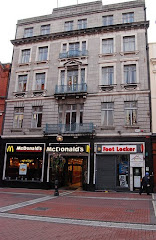
I can't believe it has already been a week since we left Ireland! I felt like it was yesterday---I was so sad to return to the States! For my project, I decided to focus on immigration. During my time in Ireland, I befriended both native Irish as well as immigrants to Ireland. In speaking to both groups of people, I found that the subject of immigration was an important and highly contentious issue. Traditionally, Ireland has been a land of emigrants, in which the country's citizens have left the land for a chance of a better life. This issue was most apparent during the Great Potato Famine, which touched off mass emigration from Ireland. The Famine began in 1845 and lasted nearly 5 years. It eliminated the sole subsistence of millions of Irish, forcing many peasants to starve or emigrate to other countries. Overall, almost 3.5 million Irishmen entered the U.S. between 1820 and 1880; nearly half the Irish population at that time. However, in the last several decades, Ireland has become a country of immigration. As Ireland has grown economically (specifically with the "Celtic Tiger, " 1995-2007), Ireland has become a land of opportunity for those living in poorer countries. This huge contrast has created many cultural and political rifts in Ireland.
Overall, Ireland has a much smaller immigrant population than other countries in the UK. Although the number of immigrants in Ireland is comparably small to other European countries, the issue of immigration is emphasized due to Ireland's small size, as well as their unique history and strong traditions. Ireland has historically been a homogenous population; solely white and Irish. Further, Ireland has unique traditions include the Irish language Gaelic and step dance. Some feel that these unique traditions could be threatened by the increasing influx of immigrant populations, who bring different traditions and languages to Ireland.
Speaking with native Irish gave me an idea of the resistance and hostility some Irish feel concerning the immigrant population. Of the many people I spoke with, these are a select few. I spoke with a student from UCD named Thomas O'Mally, who seemed incredibly resistant to the influx of Irish immigrants. His father had recently lost work as a furniture maker, and he felt that the immigrant workforce had prevented his father from finding another job. On the other hand, many immigrants felt positively about coming to Ireland. I met PJ, a jewelry maker from Argentina, in the Galway street market. He said that life was far better in Ireland than in Argentina . Although he held one of the most lowly jobs in Irish society, PJ felt he lived a more comfortable life in Ireland and was able to better support his family. I also spoke with Babu, who was a service worker at the Jury's Inn at Croak Park, where my mom and I stayed for a night. Babu was from India, and was studying at Trinity. He was only allotted a visa to study in Ireland, instead of citizenship. However, Babu was working to obtain citizenship from the Irish government, and said he wanted to bring his family over from India.
Overall, I felt the contentious issue of immigration in Ireland mirrored that in America. In America, the immigration controversy is more concrete, as Arizona just passed immigration laws essentially based on one's appearance. This law is considered by many, including myself, to be incredibly discriminatory and an unreliable form of keeping immigrants out. During my presentation, we spoke about the Economist's take on immigration in America, in which America would let all immigrants in. However, there seems to be no way that this concept will be acceptable in the near future in either Ireland or America, as there is so much resistance to the immigrant population. Finally, American issues with immigration seem to be heavily divided on party lines; the Democrats generally want to loosen or uphold current immigration regulation, while the Republicans want to tighten immigration laws. However, immigration does not seem to be divided along party lines in Ireland. Rather, the issue is divided between native Irish and the immigrant population. The native Irish resistance to immigrants seems fairly widespread and pervasive in the country. Overall, I learned so much in Ireland. I miss it already!
Thursday, May 20, 2010

Saturday, May 15, 2010
Ireland Love

When I was wandering about Dublin and meeting so many new and interesting people, I realized I was trying so hard not to be the one thing I was; a tourist. When I visit a new country or place I don't want to be "that girl" who's taking pictures and asking for directions. The most important thing is to blend in. I don't really know why we often do this, or why it seems so important for us to make sure we aren't fulfilling that image of the annoying tourist complete with the overly large camera, fanny pack, and of course a tacky button up shirt. Obviously most tourists do not look like this, but every time I decide to snap a picture I can't help but wonder what the native Irish people are thinking. Maybe this tourist phobia is partially a result of where I work during the summer which is a place completely filled with with these tourists who drive all of us employees crazy most days. They all move a little bit slower than everyone else, I think they often forget that people actually live and work on this island. However, as much as we loath their ridiculous questions, their tendency to stop and stand in the middle of the road, and their awkward photo-ops, we wouldn't have a job without them.
When I brought up this question of avoiding "touristy" behaviors during the presentations I got a few answers. I remember one in particular dealing with the fact that we may be embarrassed by our country. I thought about this for a few days and I realized that this may be the root of this issue. I personally am slightly embarrassed by my country's actions in the past few years, however, I can't say for sure that this is the sole reason I hate being an "American tourist". I don't hate my country, I just think there's a lot of things that could have been done differently, which may be why I'm so attracted to foreign countries and their cultures. To me, they often are much more appealing than my own. I did notice though that Irish people do seem to like Americans. I didn't really meet anyone who had a negative opinion towards us when they found out where we were from. Though, at the same time I think its possible that America's lack of cultural cohesiveness might appeal to a country who seems to have maintained a one culture mentality.
While in Ireland, I noticed a extreme importance with the last name, certain last names have a differing levels of importance. The people who seemed most adamant about telling us their "second names" had some of the more common names I associated with Ireland, such as O'Mally and O'Sullivan. When I told some of the nice young gentleman we met that my family's Irish name was King they pretty much laughed in my face. Apparently it wasn't "Irish" enough. Whatever that means. I found that in the past, Irish last names had something to do with the way land was distributed and where people lived. I think some last names were associated in with a higher ranking than others, which has seemed to continue through today, though it is not as apparent. I found this interesting when thinking about American culture because when we ask each other who we are or where we are from we often have multiple countries and cultures we list. But, in Ireland, when you ask where someone is from they might give you their last name and tell you a part of Ireland where their family name originated. It was interesting to see how different American really is from other cultures. It would be weird to only have one place of origin rather than four or five. Overall, I found the experience in Ireland amazing, especially learning about the Irish culture. I would love to go back. Cheers! :)
Friday, May 14, 2010
Ireland and America Connection
Ireland and America: The American connection
Over my short stay in Ireland I’ve noticed a strong connection between the Irish people and America that is peculiar to most European countries. From my experiences with other Europeans, they feel somewhat connected to America threw obvious things like movies and fast food but besides these few things their connection with America is minimal. On the other hand, the Irish people appear to have a connection to America that is much stronger than their fellow Europeans. Explanations for this strong cultural bond are obvious; Irish people have been emigrating to the U.S. for almost 200 years now and many of them have family in the states.
Furthermore, the Irish people seem to have a strong aversion to anything European and dislike their membership in the European Union. Part of this animosity towards the European Union can be explained by the economic crisis happening right now, but after talking with many Irishmen I’ve found that many of them feel like Ireland “sold out” when they joined the EU. When the Irishmen talk about traveling they never speak of their journeys to the European continent, they talk about their travels in the U.S. They always talk about moving to the United States as if its their secondary place of residence—no transition, they can simply move their and become an American. This is very unusual for most people. Despite strong Irish patriotism, they will easily give up their life in Ireland for an American one.
Wednesday, May 12, 2010
Ireland Old and New
Ireland has an interesting blend of old and new, which is not found in American culture. On the island Inis Meain everyone, young and old, not only embraced traditions, but integrated the traditions into their everyday lives alongside new-age pop culture. At the pub, the adults were teaching the children the Irish style of dancing in Gaelic, and everyone was enjoying it. In America the little boys would not have wanted to learn how to dance because it is considered too girly, but that is not the case in this culture. Then, during the dance lesson one girl started texting. It was interesting to see someone embracing the past and present at the same time because that does not often happen in the U.S. One of the groups of people in our country who embrace traditions is the Amish, but they hold on to the past in exclusion of the present. Most Americans are opposite, in that they discontinue many “old country” practices, like language and other aspects of their former culture in favor of the greater American culture. It was refreshing to see a people who maintain their respect for the old ways while also accepting newer ones.
Irish traditions were such an integral part of life on Inis Meain that they also seemed to be part of the landscape. The most prominent example of this is the ancient fort on the island. It is called dún chonchúir, and it dates back to pre-Christian times. Evidence suggests that it was in use through the Medieval Ages, so it witnessed around 2000 years of island history, yet the people use it and the surrounding land for cow pastures. In the States, a monument with that kind of history would be protected and sealed off from the rest of the world, and the government would charge people to see it. On Inis Meain, however, I was free to roam around and even climb the walls. It may seem to some that the people do not care about their history if they let cows do their business on it, but the people keep traditions like dancing and language very much alive. Perhaps the parts of their culture that can be brought with them are maintained, while other parts, like buildings that stay put, are left behind.
Monday, May 10, 2010
The West of Ireland
We visited Galway and the Isle of Innismann these past couple of days. I was actually really resistant to leave Dublin because I have fallen in love with the city. I feel like I can navigate Dublin pretty well by now (maaaaybe thats a stretch) and feel pretty connected to it. Overall, Galway was beautiful and much more urban than I imagined. The city was really busy when we arrived and was bustling with activity. The crowd looked really young (college aged) in general, and the public park in the center of the city was packed with people enjoying the warmth and sunshine. I especially loved the market on Galway's main strip. I bartered with a man from Argentina for a silver ring. I talked to him for a bit and he said he came to Ireland to find work. He missed home, but he said he had a much better life in Ireland. Immigration seems to be a really controversial topic in Ireland; some native Irish seem to think that the immigrant population is eroding traditional Irish culture. In ways, this predicament mirrors America's own political and cultural tensions with immigration. However, the problem is magnified because Ireland is such a small country and they have had such strong national traditions with ancient history.
The Isle of Innismann was entirely rustic. Exploring was most fun when we were able to interact with the local people. It seemed that many people left this teeny island in their young adult years, and returned in their older age. Specifically, Sara and I saw a couple of middle aged alcoholic men at the island's only bar. It was sad to see, but rather telling, because there isn't much to do in the form of entertainment on the island. The island was mostly what I expected after seeing a movie about the Aran Islands in class. The stone fences covering the entire island were amazing. They looked like they wouldve taken hundreds of years to make. It was wild to see the sacrifices the people of Innisman made to made the land livable.
The Isle of Innismann was entirely rustic. Exploring was most fun when we were able to interact with the local people. It seemed that many people left this teeny island in their young adult years, and returned in their older age. Specifically, Sara and I saw a couple of middle aged alcoholic men at the island's only bar. It was sad to see, but rather telling, because there isn't much to do in the form of entertainment on the island. The island was mostly what I expected after seeing a movie about the Aran Islands in class. The stone fences covering the entire island were amazing. They looked like they wouldve taken hundreds of years to make. It was wild to see the sacrifices the people of Innisman made to made the land livable.
Friday, May 7, 2010
If I have ever told any of you what I plan on doing with my life, please discredit everything I said. Going to grad school at Northwestern, living in Chicago with my sister, working for some kind of newspaper, magazine, or other publication-- all of it. What I'm actually going to do with the rest of my life is live in a small, sleepy seaside town in Ireland, just outside of Dublin. There I will spend all of my euros in adorable cafes and write books at the top of my own tower overlooking the water. I'll travel by bike during the day and take a bus into the city by night, and maybe even jump off the rocky shore into freezing water to swim. Yes, life will be perfect.
That said, my favorite part of the week so far has been our short trip to one of the suburbs of Dublin near the sea. We visited Joyce's tower and walked down the shore, which was cold but beautiful. Definitely a great break from the city. Everything seemed so relaxed and quiet there, unlike the crowded streets in Dublin. And while part of me felt like a huge creep for looking at a wax mold of Joyce's head made shortly after his death, seeing his tower was fantastic. It's just unreal being that close to one of the most important writers the world has known. I mean, we even saw his vest and bed!
Don't get me wrong, I love Dublin, but having a short change of pace was refreshing. I'm hoping our weekend trip west will feel the same way. And, considering the girls received a noise violation the other night, maybe a soothing adventure is exactly what we need.
So I guess the most important things to take away from this post are:
a) I'm going to live in Ireland.
b) Charming sea towns > huge cities
c) I'm a creep. Stalking James Joyce was great and Seamus Heaney is next.
That said, my favorite part of the week so far has been our short trip to one of the suburbs of Dublin near the sea. We visited Joyce's tower and walked down the shore, which was cold but beautiful. Definitely a great break from the city. Everything seemed so relaxed and quiet there, unlike the crowded streets in Dublin. And while part of me felt like a huge creep for looking at a wax mold of Joyce's head made shortly after his death, seeing his tower was fantastic. It's just unreal being that close to one of the most important writers the world has known. I mean, we even saw his vest and bed!
Don't get me wrong, I love Dublin, but having a short change of pace was refreshing. I'm hoping our weekend trip west will feel the same way. And, considering the girls received a noise violation the other night, maybe a soothing adventure is exactly what we need.
So I guess the most important things to take away from this post are:
a) I'm going to live in Ireland.
b) Charming sea towns > huge cities
c) I'm a creep. Stalking James Joyce was great and Seamus Heaney is next.
Thursday, May 6, 2010
Terty Tree
I decided to rewrite this blog, as my original post was written a little to early in the trip for me to really write something accurate about Ireland. First of all, I LOVE Dublin and Galway, so much so that I think might actually want to live and/or study there sometime in the future. I'm a city girl for sure, but the cities I've been to in American haven't really seemed to capture my interest as well as those in Dublin. I'm not sure exactly what it is that makes them so appealing, it might be the people who are amazing to talk to and they are very welcoming. It was interesting getting to know the people, we met a few..well I guess more than a few Irish boys, who seemed very interested in teaching American girls the "ways of Ireland".
Dublin is a pretty big city, but I was surprised how easy it was to find your way around...at least it was for me. There are a lot of art museums, churches, and other touristy attractions that we were able to visit. I really enjoyed seeing Kilmainham Jail, it was interesting to learn about the history and the fact that it was still standing after hundreds of years Galway is kind of like Dublin, but it's more condensed which was a nice change from the huge city. We went on a Saturday, so there was this cute little street market that I loved. It was fun chatting with some of the local people, however, it appeared that a lot of people were tourists. I was also surprised at how much the girls dressed up to go out to the pubs. I mean girls dress up in America, but this was a little extensive. I don't remember seeing a girl who wasn't in a dress or a skirt, besides Lainey and I. ha. so we felt a little out of place. The guys even dress up, very fashionable men on the other side of the pond. :)
But anyways, I'm definitely seriously considering spending a large amount of time in Ireland so I can see more of the country, and experience more the city life on my own. The Irish people are very proud of their country and it's traditions, however, they are very cohesive and the blending of new traditions through immigration doesn't seem to be as accepted throughout the country. We came across a few immigrants which actually surprised me, I wasn't expecting to see people from Asia, South America, and Africa in a place that I thought was mostly a single culture. I'll talk more about this in my little paper. Cheers :)
Dublin is a pretty big city, but I was surprised how easy it was to find your way around...at least it was for me. There are a lot of art museums, churches, and other touristy attractions that we were able to visit. I really enjoyed seeing Kilmainham Jail, it was interesting to learn about the history and the fact that it was still standing after hundreds of years Galway is kind of like Dublin, but it's more condensed which was a nice change from the huge city. We went on a Saturday, so there was this cute little street market that I loved. It was fun chatting with some of the local people, however, it appeared that a lot of people were tourists. I was also surprised at how much the girls dressed up to go out to the pubs. I mean girls dress up in America, but this was a little extensive. I don't remember seeing a girl who wasn't in a dress or a skirt, besides Lainey and I. ha. so we felt a little out of place. The guys even dress up, very fashionable men on the other side of the pond. :)
But anyways, I'm definitely seriously considering spending a large amount of time in Ireland so I can see more of the country, and experience more the city life on my own. The Irish people are very proud of their country and it's traditions, however, they are very cohesive and the blending of new traditions through immigration doesn't seem to be as accepted throughout the country. We came across a few immigrants which actually surprised me, I wasn't expecting to see people from Asia, South America, and Africa in a place that I thought was mostly a single culture. I'll talk more about this in my little paper. Cheers :)
Wednesday, May 5, 2010
Dublin
Hey all,
Dublin has been a blast so far. I can't really think of one particular thing to write about so I'll just write about my general experiences so far. Trinity college was beautiful. The pavements are made out of old cobblestones and the student population seems exciting. The beer here is unbelievable. Even if you don't like beer you would find an Irish beer here that you would enjoy. I've noticed that any tour that we go on the tour guides end up telling you the same things that you're tour guide from another tour just told you. Dublin is surprisingly a very ethnically diverse city. Before I came to Dublin I pictured it as a primarily Irish/Anglo city with only sprinklings of indo-pakistanis and asians. Turns out that their are a lot of different ethnicities living in Dublin. Also, we saw deer in Phoniex park that were the same species as the baby deer that came to lloyd. Thought that was pretty cool.
Monday, May 3, 2010
Joy's Adventures of her First 2 Days
When I first arrived in Dublin I was a bit nervous, since I was alone, but it turned out to be just fine. I met a girl from Canada named Aviva, and we wandered around the city. We saw Christchurch, St. Patrick's, St. Paul's, St. Catherine's, and St. Augustine's cathedrals. We did not go inside them all, as that would be quite expensive, but we took lots of pictures. These churches are also in very different parts of the city, so we got to see a lot of the area, which helped today because I knew where I was at all times. The nice thing about the churches here is that they are the tallest buildings in the area and can be seen several streets away. That helps with directions a lot. In order to fight the jet lag, Aviva and I also strolled down the Liffey River and around the Temple Bar area. We had a nice dinner at a Chinese restaurant before falling asleep in the hostel.
Today I woke up, had leftover Chinese for breakfast, and walked to the apartments everyone is staying in for the trip. Upon returning, I checked out, got into a conversation with the man at the front desk at the hostel, and somehow ended up pointing out the location of the apartments on a map of the city and how to get there so that he could visit his parents when they stay there in a few weeks. Less than five minutes later I was horribly lost. I took a wrong turn on Dame Street and ended up walking with my duffel bag through a deserted residential area of town. I was wandering around for about a mile when I spotted St. Augustine's Cathedral, which I knew was very close to the St. Augustine Apartments. The only problem was that when I turned on to a street I thought would take me there it ended up winding away from the cathedral. Some minutes later I found myself on a street with some interesting graffiti, and then a taxi pulled up and asked me if I wanted a ride somewhere. Then, I looked around the corner and saw the street that the apartments were on, politely declined the taxi driver's offer, and finally made my way to the apartments.
After finding out that check in was not for a while, I decided to walk around the city some more. I walked by St. Aoudin's Cathedral and noticed that it was free admission, so I walked in. When I was looking around the church a nice old Irish woman asked me if I would like a tour. She assumed that the other girl lookning around the church at the same time was with me, so she told us about how it was the oldest church in Ireland (about 800 years old), about its importance in the community, and about all the symbolism found on the monuments. When the tour guide left to get us maps, Roberta introduced herself and we decided to walk around together. Next, we went to Trinity College, down Grafton Street, and around Stephen's Green. She wanted to know all about America, and she told me about Italy as well. Then we went to Temple Bar and shared a pot of Irish tea. After that I met up with the rest of the group, had an orientation, and went back out into the city with them. I'm pretty excited for eggs tomorrow for breakfast, which we got at the supermarket while we were out. We also went to the Brazen Head, which is a pretty old pub and enjoyed a pint of Guinness while the Norwegian choir at the next few tables entertained us with drunken singing (which was still way better than I could ever hope to sing). We saw the Norwegian choir again at a hotel pub later on that featured Irish music and dancing. All in all it has been an interesting experience so far, and I look forward to tomorrow's tour, which features the book of Kells.
Sunday, April 18, 2010
"If God Will Send His Angels" Scene
Finally...I finished my scene for my "Across The U2niverse" concept.
Here's the background of the scene:
The protagonist, David (that guy who looks strangely like me) just got done having a conversation with his best friend, Jess. They both kind of have a romantic interest in each other but neither has said anything to the other about it. Both are seniors in high school and Jess gets upset when David puts off making any sort of decision for what he is going to do the next year (Jess mostly wants him to come to the same school as her). He has applied to colleges but half of him does not even want to do. Jess accuses him of living only in his own technological retreat-world. This scene depicts David trying to make sense of things as he deals with what to make of the technological world that he is ever becoming more fascinated with--it's 1997, he has just gotten a laptop (a supreme rarity at that time for a high school student), and he is discovering the wonders of the Internet, AIM, and other related phenomena.
I have a feeling the idea makes a lot more sense in my own head...I hope this video at least communicates something that relates to what I just described.
Wednesday, April 7, 2010
Irish Music at the Ark
What I remember most about the performance, and it seems most people in the class agree, was how young the performers were. Before the show, I was looking around at the audience, and almost everyone was over the age of 50. That told me that 1) This was going to be a boring show and 2) I probably wouldn't like it. Thankfully, neither of those things turned out to be true.
My past history with "real" Irish music doesn't go very far beyond PBS specials that my parents and grandparents made me watch, and all of these shows emphasized on the historical side, and how Irish music was. What I really loved about this performance is the large emphasis that the group placed on how Irish music is.
Sure, there were old songs, and historical background to accompany them, but there were also a lot of innovations, crossovers, etc. and I really think that the group's desire to perform this music authentically and well shone through, making for a great performance and a great reflection of what Irish music is.
My past history with "real" Irish music doesn't go very far beyond PBS specials that my parents and grandparents made me watch, and all of these shows emphasized on the historical side, and how Irish music was. What I really loved about this performance is the large emphasis that the group placed on how Irish music is.
Sure, there were old songs, and historical background to accompany them, but there were also a lot of innovations, crossovers, etc. and I really think that the group's desire to perform this music authentically and well shone through, making for a great performance and a great reflection of what Irish music is.
Saturday, April 3, 2010
Fintan and Irish Dance
Sorry for the late post! I wanted to explore why Irish dance has made such an impact in America. Fintan talked about how traditional Irish dance wasn’t extremely popular in Ireland, but became a success in the US. America is such a diverse, heterogeneous culture; a true hodge-podge of different cultures and traditions. As such, I think many Americans seek out characteristics/customs of their unique heritage in an attempt to identify with their native culture. In a sense, I believe this is some of the appeal of traditional Irish dance in America. Irish-Americans may feel more connected to their native land by watching Irish dance. They may think of Irish dance as “authentic,” because the tradition is originated directly from Ireland. Fintan also describes the dance as an expression of displacement, which speaks to the offspring of Irish immigrants. For native Irish people, this form of dance may not seem as novel, and probably seems rather archaic. For Irish Americans, it is a mode for connecting with their ancestry and heritage. I know this rings true for my family and home community. The people in my community practice Irish customs, such as traditional dance and involvement in the Catholic Church, to feel connected to Ireland and to their heritage.
Friday, April 2, 2010
Irish Bands
After Sara played the Dropkick Murphy's song, "Shipping up to Boston," I've been listening to it constantly for the past two days and trying to analyze the lyrics. Besides the Irish melodies of this band and their associations with Boston (which is one of the most Irish cities in America) their isn't anything particularly Irish about them that I can find. The lyrics to "Shipping up to Boston" seem to have no Irish meaning (or even any meaning in general) that I can find. So what makes this band so Irish and what draws people to them? The only explanation that I can think of to this question is the sound of the band. The dropkick murphy's have a distinct Irish sound to them that reminds me of Irish folk music. Now, most people are no longer interested in Irish folk music so why would so many people be drawn to this band? The answer to this question is the murphy's new twist on Irish folk music, turning it from a soft sounding music to a loud and metal like music that is more appealable to music audiences today.
Stealing My Own Thunder
Not that anyone's going to read this by the time I give my presentation in a few hours...but I'm kind of giving away part of my presentation...Bah! Oh well...
U2 has, in a way, always had the idea that they do not want to sound quite like anyone else. That's why they've reinvented themselves about a dozen times in thirty years. More on this in a bit...;)
Seriously, though, U2's real roots are themselves. Their inspiration is whatever they want it to be. It's not predetermined. U2 is very particular about what music they put out--they have hundreds of songs basically stuck in the archives that leak out here and there that are really good but that they don't want to release because they are not about fulfilling a set profile on each album--they are about forging into new territory.
Traditional Irish bands are rooted strongly in being Irish. It's what they fall back on. In one sense it's just as wonderful as U2's desire to always be changing, this being strongly rooted in tradition. It's hard to find something as rich as a tradition like that on your own. It's resting on the shoulders of a giant--whatever way you want to take that.
I feel like I more or less said what Natalie said...but that's basically what it is.
U2 has, in a way, always had the idea that they do not want to sound quite like anyone else. That's why they've reinvented themselves about a dozen times in thirty years. More on this in a bit...;)
Seriously, though, U2's real roots are themselves. Their inspiration is whatever they want it to be. It's not predetermined. U2 is very particular about what music they put out--they have hundreds of songs basically stuck in the archives that leak out here and there that are really good but that they don't want to release because they are not about fulfilling a set profile on each album--they are about forging into new territory.
Traditional Irish bands are rooted strongly in being Irish. It's what they fall back on. In one sense it's just as wonderful as U2's desire to always be changing, this being strongly rooted in tradition. It's hard to find something as rich as a tradition like that on your own. It's resting on the shoulders of a giant--whatever way you want to take that.
I feel like I more or less said what Natalie said...but that's basically what it is.
Thursday, April 1, 2010
The Night My Social Interaction Skills Were Shattered
Like others have mentioned, our night at the Ark was a wonderful experience. I, along with most other people, have been exposed to Irish music before, be it on Pandora radio, St. Patrick's Day inspired car commercials, or my friend's dance recitals. Hearing it live, however, proved to be completely different, and soaking up the musicians' energy was an exhilarating feeling.
That said, the musicians themselves were probably the most surprising part of the night. As I said in class, I didn't expect them to be Irish. I know, the idea of a traditional Irish band made up of Americans seems ludicrous now, but it made sense at the time. It was probably some of the themes we've talked about in class that made me feel this way, like not fully relating to a culture because one grows up with it or Ireland's insecurities. To me, it made more sense for a group of rugged, elderly American men to be playing the music, nostalgic for the "good old days" in a country they've most likely never been to. The fact that young, energetic Irish musicians are genuinely excited to play their country's music was shocking but almost refreshing; it's rare, after all, to find young Americans playing traditional music with so much enthusiasm. I mean, these musicians travel the world playing their music, songs they've probably grown up with. I, on the other hand, have come to loathe certain songs I felt were forced upon me as a kid. If anything, the concert made me feel less touristy and romantic for being interested in traditional Irish music and culture. If it's still relevant to the youth of the country, it must not just be a tourist trap.
It's late and I'm rambling, so I won't get into one of the most embarrassing moments of my life that took place after the music. I won't mention making extended akward eye contact with the cool Chicago piper or blushing obviously while being introduced to the cool Irish musicians. No, I'm not going to swallow my pride that much tonight. For the record, though, I still feel socially awkward.
That said, the musicians themselves were probably the most surprising part of the night. As I said in class, I didn't expect them to be Irish. I know, the idea of a traditional Irish band made up of Americans seems ludicrous now, but it made sense at the time. It was probably some of the themes we've talked about in class that made me feel this way, like not fully relating to a culture because one grows up with it or Ireland's insecurities. To me, it made more sense for a group of rugged, elderly American men to be playing the music, nostalgic for the "good old days" in a country they've most likely never been to. The fact that young, energetic Irish musicians are genuinely excited to play their country's music was shocking but almost refreshing; it's rare, after all, to find young Americans playing traditional music with so much enthusiasm. I mean, these musicians travel the world playing their music, songs they've probably grown up with. I, on the other hand, have come to loathe certain songs I felt were forced upon me as a kid. If anything, the concert made me feel less touristy and romantic for being interested in traditional Irish music and culture. If it's still relevant to the youth of the country, it must not just be a tourist trap.
It's late and I'm rambling, so I won't get into one of the most embarrassing moments of my life that took place after the music. I won't mention making extended akward eye contact with the cool Chicago piper or blushing obviously while being introduced to the cool Irish musicians. No, I'm not going to swallow my pride that much tonight. For the record, though, I still feel socially awkward.
Celtic Crossroads: Awkward Encounter/Awesome Night
Despite our incredibly awkward picture-taking experience with Celtic Crossroads after the show, I still had a fabulous time. I think something that particularly surprised me was that we were actually nervous to take a picture with the band afterwards...because they were awesome. They were young and hip and immensely talented. They were also very, very proud of their culture. One of the things we discussed in class on Wednesday was how they were almost apologetic for the one band members who were from Chicago and Denmark. But at the same time, I felt that had these members not fully embraced the Irish culture and learned everything possible about the instruments they played, and had both deep passion and deep respect for traditional Irish music, they would have never been in the band. You could tell by watching these guys that passion was a must. They were young and energetic but they were committed to these instruments and what it meant to the culture.
I think something else that surprised me was how deeply moved I was by the music. I’m not Irish and have no explicit connection to the music in any way shape or form, and yet I could feel the power behind the instruments. The harp solo especially—I closed my eyes during it and could picture images of Ireland, images of a land that wasn’t mine, but, as possessed through their powerful music, was most definitely theirs.
I also thought it was amazing how versatile they all were. They all played at least two different instruments, a couple of them did some outrageously amazing dance moves, and it seemed as though there was nothing the lead singer couldn’t do. They also seemed to understand that their audience may not have the same connection as they do with the music, but they were more than willing to help us make some kind of connection with it and enjoy it both for its beautiful sound and its deeper meaning.
Celtic Crossroads
I really enjoyed the Celtic Crossroads performance. I wasn't really sure what to expect. I agree with what was said in class about the age of the musicians surprising me; I didn't expect them all to be so young. Their multiple talents were very impressive as well, everyone playing at least two instruments, some singing, some dancing. They seemed like a fun, exciting bunch of people. I guess I wasn't really expecting that, but like I said, I didn't really put a whole lot of thought into what to expect from the group.
I thought their song choices were interesting. They played a good mix of traditional and modern music. They described the modern songs as influenced by other regions of Europe. Hungary stands out to me as one they mentioned because one of the songs they played sounded very Hungarian, using Irish instruments. I thought it was interesting that the newer music is sort of a combination of musical styles from different regions. I was also interested by the fact that they played an American song. I can see why they did so, since they were in America and they were appealing to the audience, but I didn't really think it was necessary. They're an Irish music group, so the people coming to see them should be expecting Irish music, right? They shouldn't have to play an American song to cater to the audience. I mostly bring this up because it seemed like Cotton Eyed Joe was one of the most enjoyed songs of the concert. Everyone in the Ark seemed to really enjoy it--I include myself in that--some even considering it a favorite part of the concert. Even though I enjoyed it, in my mind it should have secondary importance to the more authentic music they played. But I find myself wondering if I'm making way too big a deal out of it. That's entirely possible. I think it does tie in, though, to what we discussed in class about the apologetic nature of the group when it came to their non-Irish members. There was this assumption that everyone had to be Irish to be in the group and that their music was supposed to be Irish, and I seem to be perpetuating the latter. The presence of non-Irish musicians certainly doesn't detract from their performance, but does it detract from their authenticity? I'm not sure.
I thought their song choices were interesting. They played a good mix of traditional and modern music. They described the modern songs as influenced by other regions of Europe. Hungary stands out to me as one they mentioned because one of the songs they played sounded very Hungarian, using Irish instruments. I thought it was interesting that the newer music is sort of a combination of musical styles from different regions. I was also interested by the fact that they played an American song. I can see why they did so, since they were in America and they were appealing to the audience, but I didn't really think it was necessary. They're an Irish music group, so the people coming to see them should be expecting Irish music, right? They shouldn't have to play an American song to cater to the audience. I mostly bring this up because it seemed like Cotton Eyed Joe was one of the most enjoyed songs of the concert. Everyone in the Ark seemed to really enjoy it--I include myself in that--some even considering it a favorite part of the concert. Even though I enjoyed it, in my mind it should have secondary importance to the more authentic music they played. But I find myself wondering if I'm making way too big a deal out of it. That's entirely possible. I think it does tie in, though, to what we discussed in class about the apologetic nature of the group when it came to their non-Irish members. There was this assumption that everyone had to be Irish to be in the group and that their music was supposed to be Irish, and I seem to be perpetuating the latter. The presence of non-Irish musicians certainly doesn't detract from their performance, but does it detract from their authenticity? I'm not sure.
The Irish Dance
First, I am not really surprised that such a great dance was born out a sort of oppression. Fintan says “that dancing was about avoiding communication, but instead became a way of escape”, which many forms of expression are. If we look at writers such as Emily Dickerson or someone like Sylvia Plath and even Maya Angelou, who all are great poets, they all have been through such great tribulations in their life and it shows in their poetry. Also, Fintan talks about how the dance was not really popular in Ireland but when it got over in American it was a hit. This is something else that doesn’t surprise. An “Irish Dance” will not be necessarily popular in its own land, simply because no one has approved it. For example, if an artist wants to really be known as a great artist, they will have to expand beyond their city and their region, and go outside of the United States, and that is how you know that you’ve made it. So, by the dance expanding outside of Ireland, it is a sign that the dance has been approved. I think it seems to be popular among Irish immigrants simply because the dancing is a part of their heritage and in the United States they get to express it. Finlan states that when the government banned the dancing, immigration increased. Now that these immigrants are in the United States, they finally get to express it.
Celtic Crossroads
The Ark is a great place, but it is not popular among college students because it tends to tailor its shows toward the older generations. That is why I was surprised that a group like Celtic Crossroads was featured there. The musicians and dancers were much younger than I expected, not because young people do not play Irish music, but because of where they were playing and who they were playing for. The majority of the audience had the gray hair and wrinkles of older parents and grandparents, who often listen to music from when they were young. Perhaps I am wrong to stereotype though. I also enjoyed the modern twist they put in their music. Looking back, I should not have been so surprised that the audience liked it too, even though they were older. Clearly they can recognize talent no matter what kind of music it plays. I was expecting something a bit more traditional, but it was very interesting how they incorporated a wide range of styles into their show.
I also noticed that Celtic Crossroads kept to the theme of loss in their lyrics, which has been a common motif throughout the class. Even the American song they chose to perform was about loss. The lyrics are “If it hadn’t been for Cottoneyed Joe, I would’ve been married a long time ago. Where did you come from? Where did you go? Where did you come from Cottoneyed Joe?” The suffering and loss in this song, as well as one of the others they sang, is masked by upbeat music and a joking tone, as if they are laughing at themselves to keep from feeling sad. This is an interesting way of dealing with one’s feelings, and it is uncommon for Americans to deal with their feelings in this way. Perhaps some of our music would be less whiny and annoying if our artists used this technique.
Subscribe to:
Posts (Atom)